

-
LESSON ONEGod’s Empowering Presence9 Activities1 Assessment
-
LESSON TWOGod-Exalting Worship8 Activities1 Assessment
-
LESSON THREEDaily Spiritual Disciplines8 Activities1 Assessment
-
LESSON FOURLearning and Growing in Community8 Activities1 Assessment
-
LESSON FIVELoving and Caring Relationships8 Activities1 Assessment
-
LESSON SIXChristlike Servanthood8 Activities1 Assessment
-
LESSON SEVENGenerously Shares the Love of Christ8 Activities1 Assessment
-
LESSON EIGHTWise Life Management and Accountability8 Activities1 Assessment
-
LESSON NINENetworks with the Body of Christ8 Activities1 Assessment
-
LESSON TENStewards a Life of Abundance8 Activities1 Assessment
-
Course Wrap-upCourse Completion2 Activities
Participants 176


Welcome to Becoming a Healthy Disciple
Healthy disciples make healthy churches. Healthy churches make healthy disciples. In this course you will learn the ten values and traits that are essential for vital individual and corporate discipleship. You can use this paradigm to deepen your own life as a beloved disciple and to create ministries that will support and encourage God-honoring discipleship in others.
Learning Outcomes
By completing this course, you will be able to:
- Define healthy discipleship in terms of three movements: Spiritual Vitality, Spiritual Community, and Spiritual Ministry.
- Articulate 10 traits of a healthy disciple and a healthy church.
- Explain the Scriptural foundation for wholehearted discipleship as modeled by Jesus and his Beloved Disciple, John.
- Examine the vitality of your own life of faith and your faith community based on 50 practical principles.
- Develop an action plan that will deepen your discipleship and equip you to disciple others.
Course Introduction
This course is based on Becoming a Healthy Disciple and Becoming a Healthy Church by Stephen Macchia. While those books are not required for this course, you may want to purchase one or both of them to deepen and enrich your understanding of discipleship. You can purchase them here.
I wrote Becoming a Healthy Disciple on the basic premise that if two or more disciples of Jesus are pursuing the same priorities in life and service, they will have a very positive effect on the whole church. Disciple health and church health belong together, and when they are pursued in parallel fashion, the resulting transformation in the body of Christ is beyond measure.
Throughout this course I will be referring to a graphic that illustrates the three dimensions and ten traits of healthy discipleship.
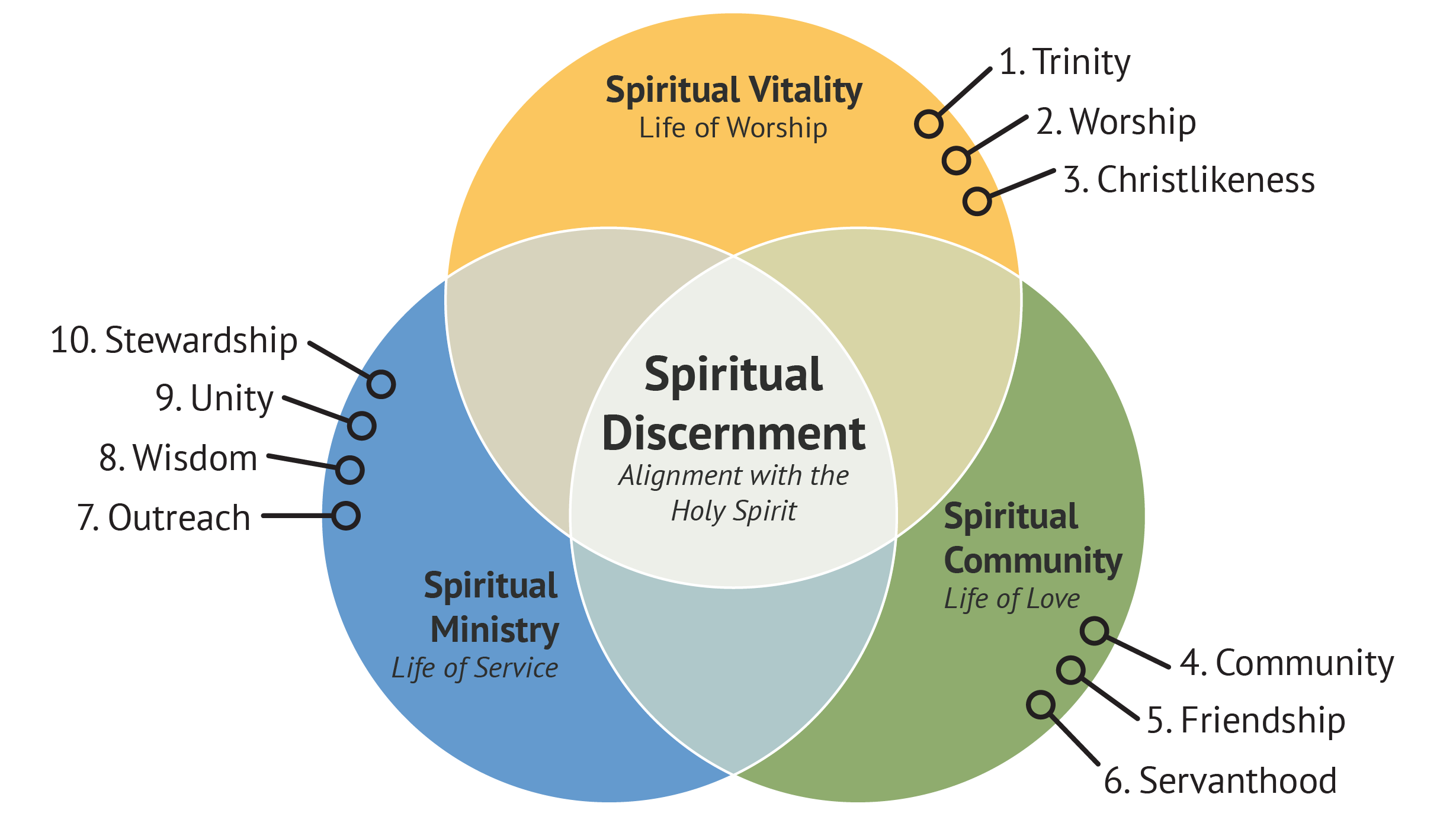
Watch this introductory video in which you are introduced to the course and the ten traits of healthy discipleship noted in the graphic above.
Watch
Greetings, my friend. Steve Macchia here. I want to welcome you to our “Becoming a Healthy Disciple” course, where we will spend a good bit of time together in the coming lessons, talking about what it means to be and become a disciple following Jesus, in this contemporary culture that we find ourselves in. We’re going to learn that discipleship is much more than learning how to have a quiet time and how to offer a testimony, even though those two skills are very important for us to know how to do. But it really begins with our heart. Where is our heart for God? And how is it with your soul, your heart today, as you’ve been redeemed and in continuous sanctification and renewal, growing in your love and affection for God from the inside out?
That’s where we’re going to go in this course. We’re going to look at the state of our heart, our heart for God, our heart for Jesus, and we’re going to watch how God does the regenerative work that only He, by His Spirit, can do. We’re going to discover that discipleship is a lifelong journey. It’s a journey of grace and growth in Jesus Christ. You see, discipleship with Jesus was as simple for His immediate followers as the very two-word instruction, “Follow Me.” Very simple instruction, “Follow Me.” Jesus said, “Follow Me, and I will make you fishers of men. Follow Me, and I will help you turn the world upside down. Follow Me, and I’ll give you the gift of the Spirit to guide and direct and uphold you when I’m gone from you.” “Follow Me,” said Jesus, “and you will lead a revolution that will last until I come again. Follow Me, and you will share all eternity by My side.” These are the comforting words of Jesus, “Follow Me, follow Me, follow Me, and you will live a full and fulfilling life.”
I love considering Jesus’ invitation to me today, “Steve, follow Me, and I’ll bless you as my beloved child. I will love you simply because of who you are, not what you do, not what you’ve accomplished, not what you own.” You are loved unconditionally and extravagantly by Jesus Himself. And so, you and I are going to discover together how we, too, like the beloved disciple John, are also beloved disciples today. But the beloved disciple John is going to be our example, and so we’re going to pay attention to his life, we’re going to look at his faithfulness, we’re going to have a fresh view of his devotion to Jesus. We know that the Scriptures, particularly The gospel of John, teach us the multiple times that we see the beloved disciple close to Jesus.
It begins early on in their relationship, but even in that critical time at the end of Jesus’ earthly life, we see John, the beloved disciple, emerge as an affectionate follower of Christ. “Follow Me,” said Jesus, and John took those words seriously. So in the latter part of Jesus’ earthly life and ministry, we see the beloved disciple reclining at the table at the Last Supper, close to Jesus. He made a choice. Everyone had an opportunity, he chose to follow Jesus intimately, closely. And so, we continually see him at that place where Jesus is saying, “Come close, draw near, follow Me.” And John, the beloved disciple, is there. We also see John, the beloved disciple, at the cross when Jesus is entrusting His mother to him. He’s saying, “Son, this is your mother. Mother, this is your son.” In other words, “When I’m gone…” he had such an affection for His own earthly mother that He entrusted his best friend, His most devoted follower, to care for His mother in his absence. We see the beloved disciple running with Peter to the open tomb, and believing all that Jesus had said in prior times. We see that the Scriptures tell us, “And he believed.” So he believed with clarity what he had been told multiple times by Jesus Himself. We also see the beloved disciple recognizing the Lord after his resurrection, and they’re having a breakfast party at the edge of the beach and John is there, John is a part of this experience, and he notices, he sees Jesus. And then he follows Peter and Jesus at a close distance when they’re having a heart-to-heart. Jesus is saying to Peter, “Do you love me?” And Peter says, “You know I love you.” And then Jesus says, “Feed my sheep.” “Do you love me?” He says the second time. And Peter says, “Yes, you know I love you.” And then a third time, He says, “Peter, do you love me more than these? More than these?” And he says, “Yes, I do.” That threefold affirmation that Peter offers to Jesus is such a powerful story for us to consider, because it was the theses that Jesus was asking, “Do you love me more than…” “Do you love me more than these fish that you just caught and could go make a profit on? Do you love me more than these disciples love me? Or do you love me more than you love these disciples?” You see, the question is critical, and it’s important for us to consider today. Do we love Jesus more than all the theses of our life that would distract us and keep us from deepening our affection for God? We see as well that the beloved disciple was a witness to what had happened, and he wrote down what he had seen. And so the gospel of John is held for us because of the obedience of the beloved disciple.
And so, we want to promote and discuss a holistic understanding of discipleship. Again, more than a quiet time and a testimony, we’re going to see in this course that it’s the entirety of our life that matters to giving ourselves back to God as He has so generously given to us. We’re going to be looking at a paradigm that I created over the past several years, as we’ve been studying what makes for a healthy church and what makes for a healthy disciple. And the values of both are parallel to one another. So even though we’re going to be focusing on becoming a beloved or healthy disciple, these same values, these same traits are seen in the life of the church as well. So if you’re a church leader, you want to consider the Becoming a Healthy Church material. If you’re a disciple of Jesus and you’re part of a small group, or part of a congregation, or part of a family unit that cares about growing in Christ, you’re in that beloved disciple category.
We learned all of this because we had done some extensive research. We went to 200 churches to visit them and to interview lay leaders and pastoral staff members. We looked at the biblical text. We had leadership consultations. We did two massive surveys of nearly 2,000 individuals each. And throughout all of that research, we came to great agreement on the traits that spanned theological background, spanned denominational affiliation, geography, ethnicity, male, female, young, old. There were 25 different ways we looked at our data and every single sub-strata of our data pool said the exact same thing, that these are the 10 values of a healthy disciple, a healthy church. And these values can be perceived as principles and/or practices. So we’re going to look at a paradigm together that outlines these traits in sort of a linear format, one through 10, but I want you to see them as a dynamic paradigm with values that interact with each other. So, even though they’re separate and we’re going to cover them one at a time in our course together, when you combine them you see a beautiful picture of what a healthy church looks like, filled with healthy or beloved disciples just like you and me. There’s no such thing as a perfect church, there’s no such thing as a perfect disciple, but when we are submitting our lives into the generous hands of God, He takes everything that we are, everything that we have, everything that we’ve experienced in life, and He desires to redeem all of it for His glory. The good, the bad, the difficult, the suffering, the pain, the heartache, the disappointment, all of it— God wants to redeem for His glory.
And so we’re going to look at this paradigm. We’re going to unpack it one value, one principle at a time and, hopefully, by the end of this course, you will have a fuller understanding of what it means to follow after God with everything that you are, everything that you have, every relationship that’s been a part of your life, because it’s the totality of our life is what we’re looking for. We’re looking at a holistic understanding of discipleship. That it’s our personal life, it’s our ministry, it’s our relationships. And we need to learn what it means to be totally reliant upon God’s power, the Spirit’s power. And we need to continually discover, afresh, the authority of God’s word. I like to look at this as sort of like motherhood and apple pie of a healthy disciple or a healthy church. What is motherhood and apple pie we all need? Is the word of God and a prayer life. So what you’re going to see in these values is you’re going to see these values expand and become a part of this fuller-orbed understanding of what it means to be a beloved disciple. And they’re going to be joined together, they’re going to be meshed as one, because we’re really talking about one life, our life, your life, my life. And our life as individuals is not a perfect life either, so there’s no such thing as a perfect church or a perfect disciple.
In our imperfections, however, God delights to work. And that is just amazing. That is astounding to me that because of his unconditional love, because He is dearly devoted to the church that He created and loves, that we too are to be a part of building healthy churches by becoming healthy disciples. And so it’s a holistic understanding of discipleship, and we’re going to cover each of these 10. The first one you’re going to learn about is that we value the Trinity; Father, Son, and Holy Spirit. And particularly in this first value, we are going to talk about what it means to experience God’s empowering presence, which is really the ministry of the Holy Spirit. Why? Why do we put emphasis there? We put emphasis there because many of us think of Father, Son, and Holy Bible rather than Father, Son, and Holy Spirit. So we’re going to talk a little bit about the Holy Spirit.
Secondly, we’re going to talk about the value of worship, that we, as healthy disciples, engage in God-exalting worship. It’s not worship of a person. It’s not worship of a place. It’s worship of God. And so we’re going to talk about what it means to be a healthy disciple that engages in worship, participates in worship, and gives one’s life into the context of community at worship together.
The third value we’re going to unpack is Christlikeness, particularly through the spiritual disciplines or the spiritual practices. We’re going to talk about the basics here that can be expanded upon in multiple ways. What does it mean to be Christ-like? It begins with the life of the disciple in their prayer closet. So we’re going to talk about your prayer closet.
Number four, we’re going to talk about the value of community. That we learn and grow together best when we’re in community, when we’re in relationship with one another, not just in the worship setting but in a small group or in a Bible study, Sunday school class. Those places where it’s safe for us to ask all of our questions and explore the biblical text with an openness and a receptivity to the work of God in our heart and in our midst.
Number five, we’re going to talk about the value of friendship. That a healthy disciple and a healthy church commits to loving and caring relationships. So we practice hospitality to one another through the gift of friendship. We can talk about the importance and the value of friendship, and I’m excited about that topic as well.
Number six, we’re going to talk about servanthood, what it means to express our giftedness in the context of the body of Christ and in the wider world. Do you realize that you have gifts and abilities, you have passion and influence in your world? Where does that come from? Well, it comes from God, and He wants you to be fully alive in the gifts and the abilities and the calling that’s on your life.
Number seven, we’re going to talk about outreach. This is a big, big one. It’s where we share the love of Christ generously, both in word and deed. You may be wondering, “Why does outreach end up as number seven when we’ve been taught so much in our life that it’s all about outreach, it’s all about sharing the gospel with others?” And it is, it certainly is, but that comes out of a life that’s walking with God and in the context of a healthy community, that we have the most effective outreach in the wider world. We’re going to talk about that.
Number eight is the value of wisdom. We are called to manage our lives wisely and accountably. Very few of us like the word “accountability,” but it is absolutely essential for health and vitality in our walk with God and our walk with one another. So we’ll unleash that word together in session eight.
Number nine is the value of unity. And it’s basically taking the passage from John 17 where Jesus is praying to the Father, praying for His disciples, and praying for us as future disciples, that we are to find unity in the body of Christ. We are to pursue unity. We are to be builders of unity, not disunity, not disloyalty, not running from church to church, place to place, and walking away from each other. No, what does it mean to walk toward one another and to grow together in our affections for God and His call in our life?
And then number 10, we’re going to talk about the value of stewardship and generosity that we are to steward a life of abundance. That’s our call. What does it mean for you to be a good steward of the resources entrusted to your care? And how are you going to be generous with them?
So friends, we’re going to live attentively to Jesus. We want to develop whole-hearted devotion to Him. We want to understand what it means to follow faithfully after Him, and I hope and I pray that this will feed into your passionate pursuit after the heart of God, knowing that the lifestyle that we’re inviting you into and the mission that’s on your life will radically transform you from the inside out. And so, to all who received Him, to those who believed in His name, He gave the right to become children of God. And that is what He has given to you and to me. Let’s become healthy disciples. Let’s pursue the values of church health and discipleship health. Let’s do it together and let’s watch what God does in our hearts and in our midst. God bless you, friend.
Lesson Overviews
Select the headings of each lesson to read about the specific learning outcomes that you will achieve by working through the content of each lesson.
The healthy disciple understands the role of the Holy Spirit and lives daily with a fresh reality of his power and presence. In this lesson, you will learn how to experience God’s empowering presence in your life and church.
When you complete this lesson, you should be able to:
- Define the role of the Holy Spirit.
- Articulate principles for living a Spirit-empowered life.
- Explain the scriptural evidence for the ministry of the Holy Spirit and the biblical definition of Spiritual fruit and gifts.
- Examine the movement of the Holy Spirit in your life and the fruit that are a natural product of God’s empowering presence.
- Develop a plan to strengthen your experience of God’s presence and help others to identify their Spiritual gifts and fruit of the Spirit.
The healthy disciple engages wholeheartedly in meaningful, God-focused worship experiences on a weekly basis with the family of God. In this lesson, you will learn how to prepare for, and engage in, wholehearted, love-based worship.
When you complete this lesson, you should be able to:
- Define wholehearted worship.
- Articulate principles for practicing total, love-based worship.
- Explain the scriptural basis for worshipping in Spirit and truth.
- Examine your worship preparation, style, and engagement.
- Develop a plan to reduce distraction and enhance engagement in worship for yourself and others.
The healthy disciple pursues the daily disciplines of prayer, Bible study, and reflection in the quietness of one’s personal prayer closet. In this lesson, you will examine the Spiritual habits that allow you to abide in Christ continually.
When you complete this lesson, you should be able to:
- Define daily Spiritual disciplines.
- Articulate the principles for practicing them in order to cultivate a deeper relationship with God.
- Explain the scriptural basis for Jesus’ commandment to abide and remain in him.
- Examine the effectiveness of your own devotional practices.
- Develop a plan to enrich and deepen your daily devotional practice and help others to establish their own.
The healthy disciple is involved in spiritual and relational growth in the context of a safe and affirming group of like-minded believers. In this lesson, you will explore how to keep learning and growing within a faith community.
When you complete this lesson, you should be able to:
- Define Christian community.
- Articulate the principles for creating a safe environment for growth.
- Explain the scriptural imperative for growth based on the community that Jesus and his disciples enjoyed.
- Examine your own experiences with, and participation in Christian community.
- Develop a plan to deepen your own growth through community.
The healthy disciple prioritizes the qualities of relational vitality that lead to genuine love for one another in the home, workplace, church, and community. In this lesson, you will learn how to commit yourself to loving and caring for others in all your relational contexts.
When you complete this lesson, you should be able to:
- Define relational health.
- Articulate practical ways to express genuine love in every aspect of your life.
- Explain the importance of expressing love and care for others in terms of Jesus’ teaching and example.
- Examine your own relationships with an eye to resolving conflict, showing grace, and encouraging others.
- Develop a plan to improve the health of your relationships and model peacemaking for others.
The healthy disciple practices God-honoring servanthood in every relational context of life and ministry. In this lesson, you will learn how to exhibit Christlike servanthood in all aspects and roles of your life.
When you complete this lesson, you should be able to:
- Define Christlike servanthood.
- Articulate the principles for exhibiting humility and submission in all areas of your life.
- Explain how Jesus modeled servanthood with his disciples.
- Examine the many ways God is calling you to serve.
- Develop a plan to expand and enhance your servanthood and empower others to serve.
The healthy disciple maximizes every opportunity to share the love of Christ, in word and deed, with those outside the faith. In this lesson, you will learn ways to share the gospel through invitational evangelism and needs-based ministry.
When you complete this lesson, you should be able to:
- Define evangelism.
- Articulate the principles for sharing God’s love and compassion with those in need.
- Explain the biblical imperative for spreading the good news beyond the walls of the church.
- Examine your opportunities to spread the gospel in your own circle of friends, local community, and the world.
- Develop a plan to share the love of Christ with others and equip fellow believers to witness outside your faith community.
The healthy disciple develops personal life management skills and lives within a web of accountable relationships. In this lesson, you will learn principles for achieving a balanced and mission-oriented life.
When you complete this lesson, you should be able to:
- Define wise life management.
- Articulate the principles for achieving wise life management.
- Explain the scriptural foundation for setting priorities based on God’s mission and calling on your life.
- Examine your own calling and how you determine your priorities.
- Develop a plan to craft your own mission statement and teach others to lead a mission-driven life.
The healthy disciple actively reaches out to others within the Christian community for relationships, worship, prayer, fellowship, and ministry. In this lesson, you will understand why it is important to connect, collaborate, and celebrate with those outside of your local church.
When you complete this lesson, you should be able to:
- Define Christian unity.
- Articulate the principles for promoting Christian unity.
- Explain the scriptural basis for unity within the Christian church based on Jesus’ own teaching and example.
- Examine areas where you can expand the reach and diversity of your network within the body of Christ.
- Develop a plan to connect, collaborate, and celebrate with the body of Christ outside your local church.
The healthy disciple recognizes that every resource comes from the hand of God and is to be used generously for kingdom priorities and purposes. In this lesson, you will evaluate how to be a generous steward of your God-given resources.
When you complete this lesson, you should be able to:
- Define stewardship.
- Articulate principles for generously stewarding the abundance of resources you have been given.
- Explain the biblical concepts of stewardship and generosity.
- Examine your own stewardship practices and opportunities.
- Develop a plan to be a faithful steward in all aspects of your life and to promote generous stewardship within your local church.
All Scripture quotations in this class, unless otherwise indicated, are taken from the Holy Bible, New International Version®, NIV®. Copyright ©1973, 1978, 1984, 2011 by Biblica, Inc.™ Used by permission of Zondervan. All rights reserved worldwide. www.zondervan.com. The “NIV” and “New International Version” are trademarks registered in the United States Patent and Trademark Office by Biblica, Inc.™
How to Maximize Your Learning from This Course
In order to maximize your learning through this online course, you are encouraged to make use of all the learning opportunities presented to you. To take full advantage of the wealth of knowledge presented in the course content, we recommend that you:
- Watch, listen to, or read all the lectures.
- Reflect on the content and questions in your journal.
- Complete all learning activities.
- Share your ideas with your fellow learners in the discussion.
- Implement what you have learned in your Action Plan.
- Enrich your learning by reading the bonus material.
Online learning is an excellent way to bring large numbers of participants together to learn and share about God’s Word. Although this course is asynchronous and therefore other participants may not complete the course at the same time as you, there are interactive opportunities to share your learning and to gain valuable, unique insights from individuals with a diverse range of backgrounds and life experiences.
What online course engagement means
Full engagement in this course further means:
- Working through the lessons in the suggested order—they’ve been arranged for a reason and each course has been designed with a logical sequence. Jumping ahead without completing the previous lesson may give you a disjointed learning experience.
- Reading and listening across a variety of learning activities—some of which are text-based, some with video. (Transcripts are provided with audio-visual resources for those learners who require or prefer the written format.)
- Sharing your learnings with other course participants in discussion opportunities.
When engaging in social learning activities, such as sharing ideas or commenting on other learners’ ideas in discussions, be mindful of how you express yourself in writing. In written communication, we do not have the advantages of interpersonal cues (e.g., facial expressions, voice tone, and gestures), so it can be difficult to express intended meaning. Remember that other course participants may have different perspectives, opinions, and life experiences than you. Therefore, when communicating online, it’s important to assume the best intentions of others and use polite and respectful language.
Technology requirements
Engaging with the materials in this course requires minimal technological skills or equipment:
- An electronic device such as a computer, tablet, or smartphone capable of running a web browser and playing video and audio.
- Internet access capable of streaming videos, loading webpages, and downloading files.
- A PDF reader (optional) for working with downloadable PDF files. Though most browsers allow PDFs to be viewed within the browser, we recommend downloading and saving them to your device so that you can save your work.
The Artos Academy app is available in Google Play and the App Store. In addition to providing full functionality of all course features, the app also allows you to download courses for offline study.
Have a question?
We have made every effort to make this course accessible for all learning styles and abilities. If you have a question or need assistance, please contact us.
What Activities to Expect
Each lesson will guide you through a series of activities. Select the headings below to read a brief description and instructions for completing each activity. Activities with a “lock” symbol 🔒 are available to premium subscribers only.
This activity offers a brief introduction to the lesson and informs you of the lesson’s objectives.
Viewing this activity is required for course completion.
This activity provides the main teaching content for the lesson. You may choose to watch or listen to the video, or to read the transcript. Closed captioning is also provided for any video segments. In each case the content is the same.
This activity is required for course completion.
This quiz activity checks your understanding of the concepts learned so far. It is not a timed activity, and the quiz can be attempted as many times as needed.
Earning a quiz score of 70% or better is required for course completion.
This activity allows you to spend time in Scripture and connect it to the topic of each lesson. Spend some time carefully reading the Scripture passage provided in the activity, utilizing the simple three-step method of Receive, Reflect, and Respond.
Complete these activities digitally in the downloadable workbook or write them in your own journal. Find the link to download the digital workbook in Lesson One.
- Receive simply involves reading the text and asking, “What does the text say?”
- Reflect challenges you to ask, “What does the text mean?”
- Respond invites you to apply the meaning of the text to your life.
Instructions for reflection
- Get and use a hard copy journal or an e-note-taking tool such as Notion, OneNote, or Apple Notes. You can also complete these activities in the course workbook, which can be downloaded in lesson one.
- Spend time reflecting on the questions provided in the activity. Make it a time of prayer by sharing your thoughts and reflections with God.
- Write down your answers, thoughts, and other revelatory ideas in your journal that God reveals during your time of prayerful reflection.
For reflective journaling activities such as this one, find a quiet place in which you will not be disturbed by other people, noises, or other distractions. Silence e-devices and quiet your mind by reading Bible passages or praying before attempting the activity.
This discussion activity is designed to help you articulate what you have learned in each lesson. It may also help you collect ideas from other course participants about their understanding of each lesson’s concepts. Since this course is asynchronous (i.e., other learners complete the course at different times), you may not see many discussion submissions or receive replies to your posts. Therefore, consider your submissions to this discussion forum as a way to share your insights about what you have learned to inspire or challenge others in their learning journey, and to enable others to do the same for you.
While other learners may not see or respond to your comments in the short term, encouraging others and engaging with others enhances your learning experience.
This activity is required for course completion.
These application activities are designed to help you consider how to put your learning to use in your own context. When you finish this course you will have an action plan that will help you deepen your own discipleship and help disciple others!
Complete these activities digitally in the downloadable workbook or write them in your own journal. Find the link to download the digital workbook in lesson one.
This section features passages from Dr. Macchia’s books related to each lesson.
This section includes additional readings from Dr. Macchia’s books or other resources that will enrich and deepen your understanding of each lesson.
This section offers a closing prayer, sums up the concepts learned in each lesson, and looks ahead to what comes next.
This activity appears in the course wrap-up section at the end of the course. It allows you to review what you have learned in the course and identify actions you will commit to in order to implement the course concepts.
Course Completion Requirements
To successfully earn a Completion Award for this course you will need to engage with all of the pages in every lesson, view all of the lectures, earn 70% or higher on each quiz activity, contribute towards the discussion boards, and complete the Course Evaluation. All other activities are recommended but not required for course completion.